




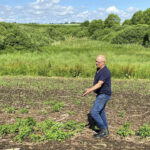
What is GLM8 – and what does it have to do with pollinator fallow?
GLM 8 (Good Agricultural and Environmental Condition 8) is one of the requirements farmers must meet to receive direct payments under the EU's agricultural subsidies. The condition requires a portion of the agricultural land to be set aside for non-productive areas or elements – including buffer areas, riparian zones, and fences.
Pollinator fallow can fulfill the GLM8 requirement because a fallow area with an approved flower mixture counts as non-productive land. This allows the farmer to place their mandatory fallow in a location that also benefits nature and wildlife, instead of empty black fallow.
What exactly does GLM8 pollinator fallow require?
- The area shall constitute the required proportion of the field block (the percentage requirement is set annually by the Danish Food Agency).
- The bare ground area must not be tilled, sprayed, or fertilized during the specified period.
- A seed mixture must be used that meets the requirements for pollinator fallow.
- The area is reported for the correct purpose in IMK (Internet Land Register) when applying for basic payment.
Biodiversity and Sustainability ordinance“
In addition to the basic payment, pollinator set-aside can be combined with the voluntary organic scheme “Biodiversity and Sustainability,” where you can apply for an additional subsidy for areas that actively promote biodiversity.
| Element | Sats |
|---|---|
| Extra subsidy rate (bio-scheme) | 2,740 kr./ha |
| Additional supplements for pollinator fallow | 1,500 DKK/ha |
Note: Subsidy rates are set annually by the Danish Food and Agriculture Agency and may change. The application deadline is typically in April – always check the current rates and conditions for the current year.
What plants belong in a pollinator mix?
A good pollinator mix combines fast-establishing annual species with perennial herbs and legumes, so the area blooms widely from early summer to autumn.
- Phacelia – very attractive to bees, fast establishment
- Cornflower and bindweed – fast-growing annuals, early cover
- Red clover and hops – perennial legumes, nitrogen-fixing, long flowering
- Chicory – sedges, good on dry soils and for game
- Buckwheat fast-growing annual with intense flower heads
- Wild carrot and caraway – screen plants, beneficial to hoverflies and butterflies
Faunamaster offers a dedicated Pollinator seed mixture, composed specifically for these purposes. See the current composition in the webshop.
Practical sowing guide
- Preparation: Choose areas with low weed competition, preferably lighter soil. Plow or till in March-April, let weed seeds germinate for a couple of weeks, and treat lightly again.
- Planting time Spring sowing (April-May) is recommended. The warmer the soil, the faster the germination. Annuals like phacelia and buckwheat can be sown until June.
- Sowing Pollinator mixes have a low seeding rate (often 8–15 kg/ha). Incorporate not the seed too deep – most flower seeds should be covered with a maximum of 0.5–1 cm of soil. An ATV-mounted seed drill such as Faunamaster S105 Doses precisely at low speed and can work in areas a tractor cannot reach.
- Finishing Rolling after sowing improves soil-seed contact. Avoid heavy watering – most species are drought-tolerant.
- Care A pollinator habitat can last 2–3 years, but should be renewed when perennial species thin out and weeds become dominant.
Frequently asked questions
Can all farmers meet GLM8 with pollinator set-aside?
Yes, as long as the area is reported correctly in IMK and meets the Danish Food Agency's requirements for the seed mixture. Check the current guidelines each year, as the rules may be adjusted.
Can pollinator fallow be combined with wild bird cover crops?
Yes. A floristically rich pollinator mix is a good supplement to cereal-based wildlife fields – the insects provide a food source for game birds and small game, while the wildlife fields provide seeds and cover. Combine the two along the field edge.
Are there requirements for the seed mixture?
Yes – The Danish Agency for Agriculture states that the mixture must contain a certain proportion of relevant pollinator-friendly flower species. Always use a documented mixture that meets the current requirements.
When is the application deadline?
Applications are submitted through the Danish Agency for Agriculture as part of the basic payment application, typically in April. Check the current deadline for the current year.
Can I use an ATV planter for pollinator fallow?
Absolutely. An ATV/UTV-mounted seeder like the S105 or S180 is particularly well-suited for strips and irregular areas where a tractor is cumbersome – and provides precise seeding without unnecessarily compacting the soil.
Get started with pollinator patches
Would you like to establish pollinator habitats that meet GLM8 requirements and enhance biodiversity? Faunamaster has seed mix "og" seed drill to work. See the full range at shop.faunamaster.com.